



Do picky eaters and meal-time meltdowns make dinner super stressful? Here’s how I get my kids to eat vegetables, and you can too. Dinner time struggles can be a thing of the past by adopting these easy rules.
Picky eating can be a pretty touchy subject. No mom wants to hear they might be making a mistake, especially once you’ve gotten to a point where it seems impossible to change the course you’ve already charted.
Over the past few months, several people have asked me for advice on this topic. I’ve pondered writing this post many times but until today, something always held me back. Even just the title seems so self-congratulatory, so smug, like somehow I’ve mastered the art of parenting, having successfully raised perfect Stepford children who can do no wrong.
So let me just say, for the record, that this post is in no way meant to be a lecture on how to parent. I love my girls to death, but they are far from perfect. Like all kids they often range from little angels to little demons, sometimes in just a matter of moments. They whine, they cry, they disobey. They fight and complain. Sometimes–a lot of times–they are downright annoying. And contrary to what the title of this post may suggest, they can often be picky when it comes to food. If left to their own devices, they would probably eat nothing but french fries and toaster strudels.

When they were born, I think I always just assumed our kids would eat everything. My husband and I didn’t plan to start making special foods for them, nor did we plan to become the parents that always made a side of chicken nuggets or mac & cheese because we knew at least that would get eaten. We didn’t intend to be the parents who handed over a bowl of goldfish at the slightest whimper, or put our kids to bed with a cheese stick or a slice of bread because they hadn’t eaten their dinner and we didn’t want them to get hungry in the middle of the night.
It just sort-of happened.
The problem with the path of least resistance is that at the time, it seems so much easier. It even seems like the right thing to do. What parent wants their child to be hungry? Until, of course, it isn’t. You go to a friend’s house for dinner and you are mortified when your six-year-old, who should know better, says rudely as the food is being served, “Ew, that looks gross! I don’t like that!” You try a new restaurant and your three-year-old has a temper tantrum because the chicken nuggets look different from the ones you serve at home.
Our rude awakening happened the day my oldest daughter refused to eat a quesadilla. Trying to be clever, I had made it with roasted vegetables instead of just plain cheese. She threw a fit to end all fits and I saw clearly for the first time that I had, for the sake of fewer arguments at dinnertime, created a picky-eating monster. I vowed then that I would do everything in my power to turn my girls into kids who would not only eat their vegetables, but everything else they were served as well.
How I Got My Kids to Eat Their Vegetables
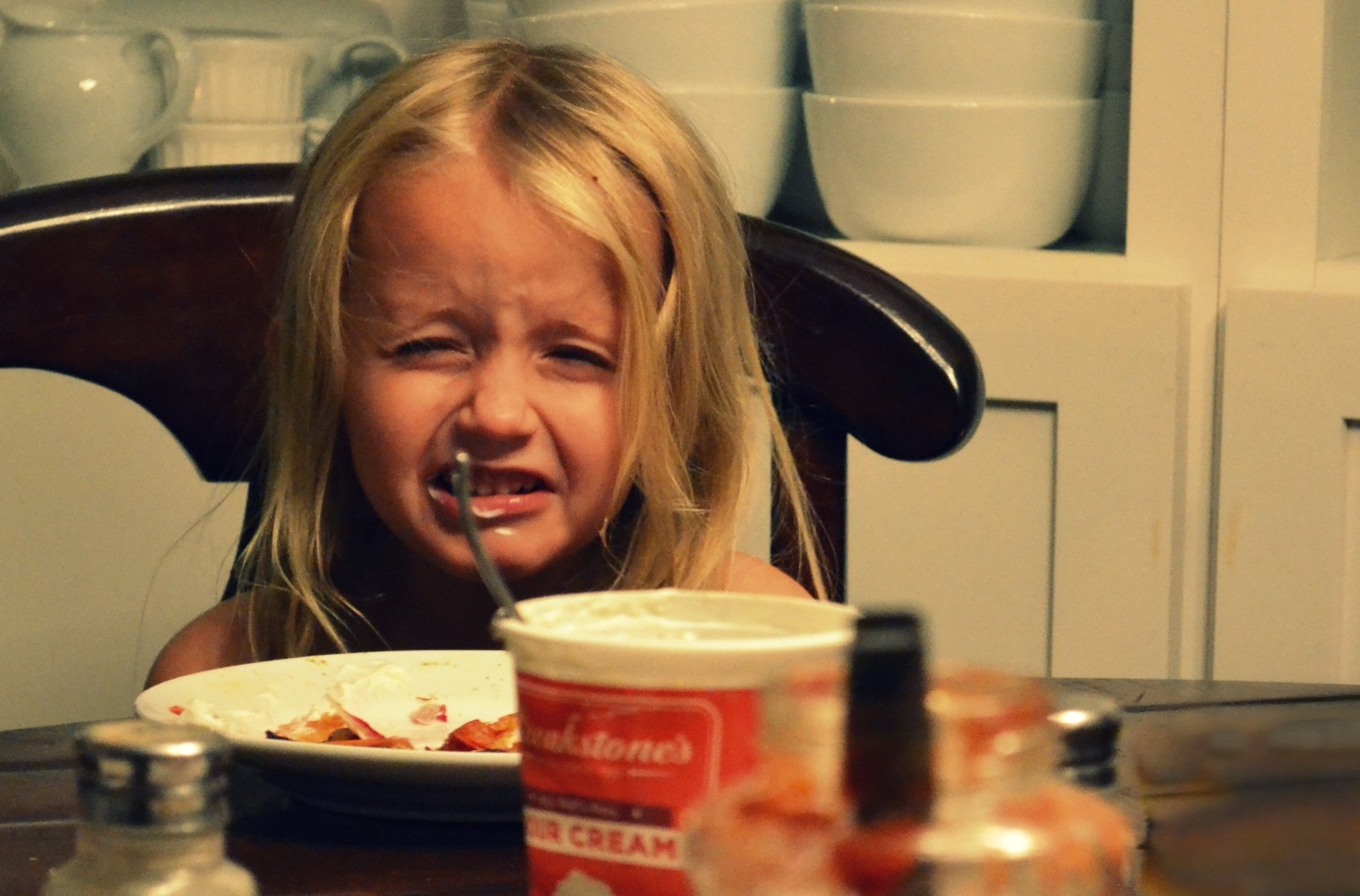
From that moment forward, my husband and I adopted five distinct strategies when it came to dealing with our kids and food:
1. Stop giving choices
We found that we were allowing our kids to dictate what they ate far too often. This doesn’t mean that we don’t still occasionally let them choose between two different meal options (we do), but for the most part, we adhere to the very wise preschool philosophy of “You get what you get and you don’t throw a fit.” Specific requests are considered, but not always honored immediately. Furthermore, we do not make separate meals. If we are trying a new recipe, whether it be fish, casserole, soup, or anything else, our kids eat what we eat. If they refuse to eat it, they don’t eat. This was something we had to enforce quite frequently in the beginning, but these days almost never. Ultimately we discovered that no kid will starve from missing a meal, and they will eat eventually.
2. The Three Try Rule
I read somewhere one time that most kids are wary of new things, and that it takes at least three separate exposures for something to become familiar. Once it is familiar, it will usually be accepted without resistance. It made so much sense that we adopted a Three Try Rule for food in our house. Our girls are not allowed to refuse a food or say they don’t like something until they have tried it at least three separate times. (Not three bites, three different meals.) Amazingly enough, we have yet to find something that they haven’t absolutely loved after the third try, even when the first try resulted in tears.
After following this rule for so long, we have found that our kids now are much more willing to try new things the first time because they understand that even if they think they don’t like it right away, they might like it eventually.
3. Limit Snacks
It is hard to get kids to try new things and eat healthy, well-balanced meals if they are constantly filling up on snacks. I can’t say that we never give our kids snacks or junk food, but it is definitely the exception, not the rule. We especially avoid snacking anytime in the two hours before dinnertime, and don’t allow snacks after dinner, especially if the child requesting the snack didn’t eat their dinner.
This is often easier said than done! The pre-dinner hour can be rough, especially for toddlers and preschoolers, and the fastest way to entertain a whiney three-year-old is to appease him with a bowl full of goldfish. Until, of course, dinner is finally ready and he refuses to eat even one bite. Then an hour later, just before bedtime, you give him another snack because you don’t want him to go to bed hungry, and the vicious cycle continues.
For me this was probably the hardest habit to break, until I finally realized that the only way to get my kids to eat well was to sometimes let them be hungry.
4. Emphasize Good Manners
We wanted our kids to understand that being picky about food and saying I don’t like that, or that looks gross, when someone else has spent time cooking for them was not only unacceptable, but incredibly rude. This meant teaching them about manners, and what it means to have good manners in all sorts of different situations, including at the table.
For this, I found a great series of books that was incredibly helpful, called the Way to Be! Manners books. Our favorites are Manners at the Table and Manners in Public. I found that reading these books frequently, then talking about them and then doing actual role playing exercises was really effective.
5. Constant Reinforcement
Being picky (and rude) is simply not an option in our family, but this rule requires constant reinforcement. Before we go to anyone’s house or to a restaurant, we will usually have a 3 minute pep talk in the car, which usually goes something like this:
Me: What are our expectations of you? Them: To be polite and use our manners Me: How do we use our manners? Them: Say please and thank you, yes ma’am and no ma’am, don’t run around, look people in the eye, clear our plates. Me: What do we do if we get served food we’re not sure we like? Them: We eat it! Me: What DO we say? Them: Thank you for this yummy food! Me: What DON’T we say? Them: I don’t like it!Even with the pep talk, they still have their moments. There have been times where we have had to pull them aside to remind them of the rules, and then make them apologize. Kids will be kids, which means constant reinforcement will always be necessary.
It has been almost two years since we revised our food strategy, and I can honestly say that it has worked wonders in our family. Going out to eat, cooking a new recipe, or visiting friends for dinner is now, for the most part, a pleasure, not a challenge, and my kids’ diet has never been so full of variety.
They are even now beginning to recognize pickiness in their friends. On a recent visit with friends, the girls watched in amazement as one of their friends went into hysterics after being served a new food, one she flat-out refused to try. As she wailed and screamed that she didn’t like it, my four-year-old, leaned over and whispered to me incredulously, Mommy, doesn’t she know she is missing out?
Raising non-picky eaters is no easy task. It means being willing to sacrifice short term peace in favor of the long-term gain. It is an exhausting and hard-fought battle, but, at least in this family, ultimately so worth the effort.
I’d love to hear your thoughts on this issue! Do you struggle with picky kids? Have you found other strategies that work for your family? Do you agree with these strategies? Why or why not?
To recap, here’s How I Got My Kids to Eat Their Vegetables
1. Stop giving choices
2. The Three Try Rule
3. Limit Snacks
4. Emphasize Good Manners
5. Constant Reinforcement
Other parenting articles you’ll love:
- How to Model Healthy Money Habits for Your Kids
- How to Help Your Kids Learn to Do It Scared
- How to Raise Grateful Kids in a Self-Centered World
PIN FOR LATER:


Ruth Soukup
Latest posts by Ruth Soukup (see all)
- Stop Worrying About Money - July 19
- How to Fit In More Fitness - April 28
- The Most Powerful Decision You’ll Ever Make - April 27
TAKE BACK CONTROL OF YOUR HOME LIFE
 Ever feel like you just can't keep up? Our Living Well Starter Guide will show you how to start streamlining your life in just 3 simple steps. It's a game changer--get it free for a limited time!
If you love this resource, be sure to check out our digital library of helpful tools and resources for cleaning faster, taking control of your budget, organizing your schedule, and getting food on the table easier than ever before.







We have tried to do this (our 5yrd old is the picky eater) and he will literally puke when he tries certain foods. He had a speech delay as a child and still has texture issues with food (which he gets from me) and for the most part will not eat what the rest of us eat, it is beyond a battle and makes meal times miserable if we try and serve him what we are eating or introduce a new food + I feel horrible for making my child eat something that is gonna make him vomit. Any suggestions on how to deal with that? It’s not only that he doesn’t want to try new stuff, the texture of some things literally make him sick. Like any type of Pasta. I was a really picky eater growing up and now eat almost anything but it took years for me to finally “try” stuff. That is my only hope that he will eventually grow out of it.
Oh my, I’m not sure how to answer that one! Have you spoken with your pediatrician?
With issues this severe, you could look into seeing a speech-language pathologist or occupational therapist, they have specialized training to help children with oral and sensory difficulties. They could provide treatment or suggestions to save you some frustration
I really really appreciate your comment Jennifer. Two very close people to me, one of which is my husband, struggle with the gagging issue still to this day! We recently had a child and picky eating is a concern for me with her because of his pickiness (which mostly is not by his choice…although some things are). I hope to help dissuade her from pickiness by having her help me with meal ideas (picking fruits/veggies at the store, helping to cook, etc). I found with my husband the best thing to do is NOT to push him or draw special attention to it. It made it worse. When I leave him be, he does try new things and even old things that made him gag. Some things still do. But he’s discovering that some things don’t anymore and are even tolerable to eat. Now granted, he’s an adult….not sure how to address a child with this issue. However, by addressing his issue, I’m hoping to dissuade non-textured pickiness from my daughter (and hoping I don’t have textured pickiness to deal with). The other person is a close friend of mine. However, she’s discovered that a lot of foods aren’t so bad if they’re cooked other ways. For example, she can’t stand cooked carrots, but raw carrots are just fine.
I can appreciate what the article is saying, especially since it is so easy to take the easy way out. But I did struggle with it (and even more so the comments) that not everything is clear cut like that. Textured pickiness is one of those things not clear cut and something I have to face with my husband, and probably with my kids at some point. I’ve found that picky eaters due to texture issues don’t necessarily want to be picky…they just are.
The gagging thing along with picky eating can be a sign of an esophageal condition whuch us not well known. My son has it and literally cannot eat a lot of foods. My husband most likely has it as well.
My daughter, like me, also has texture issues, specifically with custard-like foods such as yogurt, pudding, or even Jell-0. We finally discovered that introducing other textures made them much more bearable, even delicious! My daughter made this discovery was given banana pudding and Nilla wafers at as a snack at after-school care. She decided to crush up her cookies and add them to her pudding, which she loved. Now we both can enjoy yogurt in the morning with my son and husband by adding fresh fruit and granola. Gotta love when your kids can teach you!
That is a great story Kaitlyn! Thanks for sharing!
I’m SO glad to hear other people struggle with the gagging thing. My son gags every time we insist he tries something, and then gags some more! It’s so frustrating . I’ve resorted to making him something separate of the very small list of things he will eat. Not sure that very meal time should be a fight. The ends with tears, but I’m not sure what to do.
Sorry, I meant “a fight, THAT ends in tears”
When I was a child, there were certain foods that I thought I hated, and I felt so strongly about them when I was forced to eat them, that I did gag on them- canned peaches being a memorable example. However, there wasn’t really a physical problem going on- just getting so worked up emotionally about being forced to try something, that the gagging was more of an emotional reaction.
Jennifer, seek out a feeding team at a pediatric hospital. I know the one in my city has SLPs and OTs who work with families to develop a plan and to treat feeding disorders that are medical/sensory in nature.
I agree with the annon. comment. I have a pediatric patient that went through something that sounds very similar. Mom had him assessed by a feeding team at a hospital and he underwent therapy for certain over-developed and under-developed oral muscles. He still does speech therapy also. Your child may have something that a little therapy can help make mealtime more enjoyable for you and him both. Still continue with consistency, but seek a feeding team consultation as well!
I would seek out an occupational therapist or speech therapist who does oral motor treatment. Often not tolerating mushy textures like noodles is an oral motor issue not a sensory issue because the child does not have the skills or muscle control to manipulate the food.
I agree with this, except that I did give my daughter a snack after school and before bedtime, but what I also did differently than rule #3 was that if she asked to be excused at dinner because she was full she understood that her dinner was to be wrapped up and reheated if she was hungry before bedtime snack a couple hours later. She rarely asked and the bedtime snack was hardly something to ward off serious hunger so the conclusion was that she just wasn’t that hungry.
I want to add that sometimes we set the kids up to fail because we loudly seek out ‘kid friendly’ foods while they look on. I refused to play that game with my daughter and she pretty much always ate the ‘weird’ foods that her dad and I liked – things like tabbouleh and gyoza and sushi (our Dr almost fell off his seat when he asked her a fave food type question and her response was sashimi :))
LOL that is awesome!
Thanks for your thoughts on this! I have to admit that before I was a mom, I did have moments of judgment on my friends who struggled with this. Though my son is only 9 months old, I am already thinking about the future days and how we are going to manage the whole “food” thing because I have seen it be such a challenge for other moms. I already know that I won’t make separate meals, (unless it is unavoidable due to a food allergy) and I’m not afraid to let my child go without a meal if they are being picky and rude. I’ve had this conversation with my mom friends and some have thought I was not providing a good environment for my child by being so “inflexible.” I don’t consider this inflexible- I consider this a teaching moment. The key is to not lose one’s temper (easier said than done, sometimes) and to make sure your child always knows that you love them. I grew up in a very difficult household- something I will not emulate for my family. But giving in to a 4 year old’s demands may provide immediate peace, but long term disadvantages in the end. Thanks for being courageous- for trying new things and for sharing your experiences!! I have just discovered your blog- one of a few that I find worthy of my time. 🙂 Thank you!!
Great article! I have a 14 month old and I worry she is on her way to being picky. When is it too early to enforce your rules?
For a child that young I would just keep putting lots of different healthy foods on her plate (even foods that she didn’t want to eat at a different meal) and make sure that she’s not eating lots of snacks before meals. In my experience children’s tastes can change a lot at that age, but it might be worth talking to your pediatrician if you are concerned. They will have a lot of information and will be able to determine if she is getting enough of the nutrients that she needs.
Thank you for these suggestions. My daughter is only 10-months-old, and currently she eats everything we give her! I have given some thought as to how to handle picky eaters in the future. I appreciate you sharing how you have handled this issue in your family.