



Do picky eaters and meal-time meltdowns make dinner super stressful? Here’s how I get my kids to eat vegetables, and you can too. Dinner time struggles can be a thing of the past by adopting these easy rules.
Picky eating can be a pretty touchy subject. No mom wants to hear they might be making a mistake, especially once you’ve gotten to a point where it seems impossible to change the course you’ve already charted.
Over the past few months, several people have asked me for advice on this topic. I’ve pondered writing this post many times but until today, something always held me back. Even just the title seems so self-congratulatory, so smug, like somehow I’ve mastered the art of parenting, having successfully raised perfect Stepford children who can do no wrong.
So let me just say, for the record, that this post is in no way meant to be a lecture on how to parent. I love my girls to death, but they are far from perfect. Like all kids they often range from little angels to little demons, sometimes in just a matter of moments. They whine, they cry, they disobey. They fight and complain. Sometimes–a lot of times–they are downright annoying. And contrary to what the title of this post may suggest, they can often be picky when it comes to food. If left to their own devices, they would probably eat nothing but french fries and toaster strudels.

When they were born, I think I always just assumed our kids would eat everything. My husband and I didn’t plan to start making special foods for them, nor did we plan to become the parents that always made a side of chicken nuggets or mac & cheese because we knew at least that would get eaten. We didn’t intend to be the parents who handed over a bowl of goldfish at the slightest whimper, or put our kids to bed with a cheese stick or a slice of bread because they hadn’t eaten their dinner and we didn’t want them to get hungry in the middle of the night.
It just sort-of happened.
The problem with the path of least resistance is that at the time, it seems so much easier. It even seems like the right thing to do. What parent wants their child to be hungry? Until, of course, it isn’t. You go to a friend’s house for dinner and you are mortified when your six-year-old, who should know better, says rudely as the food is being served, “Ew, that looks gross! I don’t like that!” You try a new restaurant and your three-year-old has a temper tantrum because the chicken nuggets look different from the ones you serve at home.
Our rude awakening happened the day my oldest daughter refused to eat a quesadilla. Trying to be clever, I had made it with roasted vegetables instead of just plain cheese. She threw a fit to end all fits and I saw clearly for the first time that I had, for the sake of fewer arguments at dinnertime, created a picky-eating monster. I vowed then that I would do everything in my power to turn my girls into kids who would not only eat their vegetables, but everything else they were served as well.
How I Got My Kids to Eat Their Vegetables
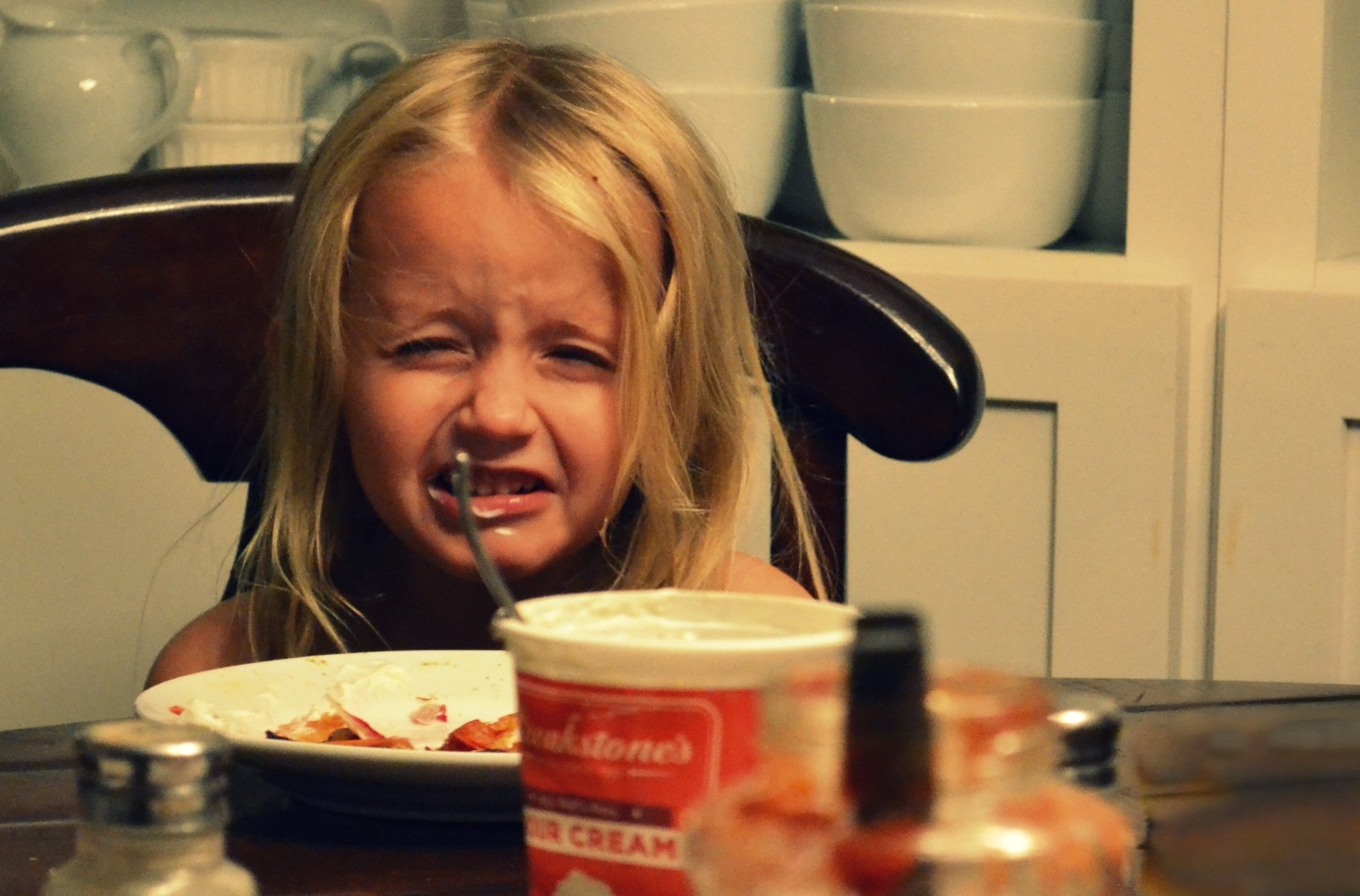
From that moment forward, my husband and I adopted five distinct strategies when it came to dealing with our kids and food:
1. Stop giving choices
We found that we were allowing our kids to dictate what they ate far too often. This doesn’t mean that we don’t still occasionally let them choose between two different meal options (we do), but for the most part, we adhere to the very wise preschool philosophy of “You get what you get and you don’t throw a fit.” Specific requests are considered, but not always honored immediately. Furthermore, we do not make separate meals. If we are trying a new recipe, whether it be fish, casserole, soup, or anything else, our kids eat what we eat. If they refuse to eat it, they don’t eat. This was something we had to enforce quite frequently in the beginning, but these days almost never. Ultimately we discovered that no kid will starve from missing a meal, and they will eat eventually.
2. The Three Try Rule
I read somewhere one time that most kids are wary of new things, and that it takes at least three separate exposures for something to become familiar. Once it is familiar, it will usually be accepted without resistance. It made so much sense that we adopted a Three Try Rule for food in our house. Our girls are not allowed to refuse a food or say they don’t like something until they have tried it at least three separate times. (Not three bites, three different meals.) Amazingly enough, we have yet to find something that they haven’t absolutely loved after the third try, even when the first try resulted in tears.
After following this rule for so long, we have found that our kids now are much more willing to try new things the first time because they understand that even if they think they don’t like it right away, they might like it eventually.
3. Limit Snacks
It is hard to get kids to try new things and eat healthy, well-balanced meals if they are constantly filling up on snacks. I can’t say that we never give our kids snacks or junk food, but it is definitely the exception, not the rule. We especially avoid snacking anytime in the two hours before dinnertime, and don’t allow snacks after dinner, especially if the child requesting the snack didn’t eat their dinner.
This is often easier said than done! The pre-dinner hour can be rough, especially for toddlers and preschoolers, and the fastest way to entertain a whiney three-year-old is to appease him with a bowl full of goldfish. Until, of course, dinner is finally ready and he refuses to eat even one bite. Then an hour later, just before bedtime, you give him another snack because you don’t want him to go to bed hungry, and the vicious cycle continues.
For me this was probably the hardest habit to break, until I finally realized that the only way to get my kids to eat well was to sometimes let them be hungry.
4. Emphasize Good Manners
We wanted our kids to understand that being picky about food and saying I don’t like that, or that looks gross, when someone else has spent time cooking for them was not only unacceptable, but incredibly rude. This meant teaching them about manners, and what it means to have good manners in all sorts of different situations, including at the table.
For this, I found a great series of books that was incredibly helpful, called the Way to Be! Manners books. Our favorites are Manners at the Table and Manners in Public. I found that reading these books frequently, then talking about them and then doing actual role playing exercises was really effective.
5. Constant Reinforcement
Being picky (and rude) is simply not an option in our family, but this rule requires constant reinforcement. Before we go to anyone’s house or to a restaurant, we will usually have a 3 minute pep talk in the car, which usually goes something like this:
Me: What are our expectations of you? Them: To be polite and use our manners Me: How do we use our manners? Them: Say please and thank you, yes ma’am and no ma’am, don’t run around, look people in the eye, clear our plates. Me: What do we do if we get served food we’re not sure we like? Them: We eat it! Me: What DO we say? Them: Thank you for this yummy food! Me: What DON’T we say? Them: I don’t like it!Even with the pep talk, they still have their moments. There have been times where we have had to pull them aside to remind them of the rules, and then make them apologize. Kids will be kids, which means constant reinforcement will always be necessary.
It has been almost two years since we revised our food strategy, and I can honestly say that it has worked wonders in our family. Going out to eat, cooking a new recipe, or visiting friends for dinner is now, for the most part, a pleasure, not a challenge, and my kids’ diet has never been so full of variety.
They are even now beginning to recognize pickiness in their friends. On a recent visit with friends, the girls watched in amazement as one of their friends went into hysterics after being served a new food, one she flat-out refused to try. As she wailed and screamed that she didn’t like it, my four-year-old, leaned over and whispered to me incredulously, Mommy, doesn’t she know she is missing out?
Raising non-picky eaters is no easy task. It means being willing to sacrifice short term peace in favor of the long-term gain. It is an exhausting and hard-fought battle, but, at least in this family, ultimately so worth the effort.
I’d love to hear your thoughts on this issue! Do you struggle with picky kids? Have you found other strategies that work for your family? Do you agree with these strategies? Why or why not?
To recap, here’s How I Got My Kids to Eat Their Vegetables
1. Stop giving choices
2. The Three Try Rule
3. Limit Snacks
4. Emphasize Good Manners
5. Constant Reinforcement
Other parenting articles you’ll love:
- How to Model Healthy Money Habits for Your Kids
- How to Help Your Kids Learn to Do It Scared
- How to Raise Grateful Kids in a Self-Centered World
PIN FOR LATER:


Ruth Soukup
Latest posts by Ruth Soukup (see all)
- Stop Worrying About Money - July 19
- How to Fit In More Fitness - April 28
- The Most Powerful Decision You’ll Ever Make - April 27
TAKE BACK CONTROL OF YOUR HOME LIFE
 Ever feel like you just can't keep up? Our Living Well Starter Guide will show you how to start streamlining your life in just 3 simple steps. It's a game changer--get it free for a limited time!
If you love this resource, be sure to check out our digital library of helpful tools and resources for cleaning faster, taking control of your budget, organizing your schedule, and getting food on the table easier than ever before.





Thank you for this. We do 2 out of the 5 of these already but we don’t necessarily enforce it 100% of the time, which is probably our downfall. I’m not an afternoon snack parent, we serve them what we eat and no other options, but reinforcement and good manners are so important! I had a friend recently tell me her kids are not allowed to say “I don’t like it” or “I don’t want it”, which is usually what I hear 50% of the time. She tells her girls they need to say “no, thank you.” To me, that is still not acceptable. We go to friends homes for dinner and they end up eating 10% of their food, usually bread and the (uugggghhhhh!!!!!) JUICE BOX they are given. I’m fed up and will be trying your tips ASAP.
Good luck Dawn! I’d love to hear back on how it goes! Keep us posted!
Along the same lines, I have a friend who has taught her 5 year old girls to say (in french) “Ce n’est pas a mon gout”, which translates into a very polite “this is not to my taste” instead of the automatic reaction of “YUCK!”… Although I would prefer EVEN better manners, where the kids get to the point of just saying thanks, I like that this approach remains polite enough not to offend most hosts.. 🙂
We do something very similar and it does work! I feel grateful that my kids will eat veggies and (mostly) try new things. One thing I appreciate about my husband is just about very meal he says to the kids, “what do we say when mom makes a yummy dinner?” And they say “thanks for dinner mom.” Then he also says, “what do we say when mom makes a yucky dinner?” And he’s gotten them to say “thanks for dinner mom!” Of course it took some coaxing but they now know and it makes me feel ok even when the meal didn’t turn out as good as I planed. I know they are being grateful.
I just had an epiphany a couple weeks ago that I too am letting my daughter too often choose what she wants for breakfast, snacks, and lunch, which is why when dinner is served she refuses to eat. It’s so frustrating, but I guess the comforting fact is that my mistake can be corrected.
It definitely can! Good luck Emily! 🙂
There are things I don’t like, but for the most part growing up my mom was the pickiest eater in our family! The only thing I disagree with here is cleaning your plate. I was taught to clean my plate. As an adult some of those things my parents drilled in to us still stick and this is one of them. I was finding myself cleaning my plate and over eating!
Cleaning their plate is actually not something we push or insist on. Our kids have to try everything that is served and eat a reasonable amount, but if they are truly full we don’t force them to eat more! My husband was an overweight kid so he is really careful about that! 🙂
i agree, cleaning the plate is not going to help…. my childhood best friend s family was told to eat everything and whenever I’m there I had to eat the food as well. I thought I was going to gag LOL…. but that friend turned to be overweight growing up…. I’m not saying nobody is perfect.. Im not thin myself but I never like to force the child to eat… we are trying to get her to eat veggies (she did eat them when she was little and even have a video of her eating broccoli!!) LOL… shes only 4 but doesnt like to see “GREEN”…. SIGH.. but just glad she likes fruits , but we dont force fruits all the time due to high sugar.. we are always looking for new ideas… sometimes she will try new stuff (even likes fish to my surprise).
If our kids are “full” before they’ve finished their dinner, we usually have them set their plate on the counter for a bit. That way if they are hungry shortly after dinner time, they get to finish what was on their plates instead of getting a new snack to eat.
I really like is idea two thumbs up.
I love this advice. I have a super picky almost 2 year old that I have admittedly gone back and forth with enforcement of your number 1 and 3 rules. It’s so hard to know what’s right when it comes to your child not eating anything because they refuse to try what you give them for dinner. She’s just so young, I think, “she’ll grow out of this when I can reason with her”, but especially after reading your blog I’m not so sure/hopeful that is the case. She is begging for cheese and crackers as soon as we walk in the door from daycare at 5ish, before I can even start dinner. It’s worse on the days she hasn’t eaten much at daycare because she didn’t like what they served. Somehow though, at daycare they can actually get her to try new things, while at home she screams as soon as I set a plate down in front of her. There is no reasoning with her at that point to “just try one bite”. Any suggestions on how to deal with that? Also, is 2 still too young to be trying this or is starting now the best time?
Laura – My kids do the same thing where they’ll eat a daycare things they won’t eat at home. I asked daycare how they’re managing this and they said (and I think this is probably a true statement) it’s mostly “monkey see, monkey do.” In other words, kids follow what the other kids are doing. If some are eating sandwiches, then most likely the other ones will follow. I think this is also true because daycare doesn’t have the time or resources to become a short order cook and make something separate for each child. Now if we can just get them to eat at home. 🙂
Can you use your slow cooker/crock pot to have dinner ready when you walk in the door? Maybe then at least you won’t have to worry about late snacks or preparing dinner with a screaming 2yo…
I’m sort of in the same boat. Miss nearly-3 has been fussy since not long after her 1st birthday, when I found out I was pregnant with her now 14mo brother. We slipped into the path of least resistance and now she’s a fussy eater 🙁 we’re going to put some/all of this into practice once we get this gastro bug out of our house.
I might add we used Baby Led Weaning with our son, and while he does have favourite parts of each meal, because he’s always had the same food we eat I think that’s helped him to experience food they way we eat it from day 1, instead of making purées, then transitioning to finger foods and then “real” food. And with the “clear your plate” rule, I’d be careful not to overload the plate and enforce that rule as I’ve read it’s a contributing factor to adult obesity from not knowing to stop eating when hunger signals stop going to the brain (not at all saying you or anyone else is doing this parenting thing wrong, just that its something to think about too)
I don’t think she meant clear your plate as in eat all the food on it. I think she meant clear your plate off the table as in take your plate/silverware/glass to the sink.
That is definitely a tough one! I’ll admit that my defenses are lowest at 5pm when I’m hungry and the kids are tired, hungry and crabby. I love Nicole’s crock pot suggestion! I think kids know how to push our limits and they also know what they can get away with. I personally don’t think 2 is too young, but I can’t make that judgement for you. Good luck! Please keep us posted on your progress!
HI, I just want to encourage any parent who is trying this. It is hard but we’ve done this from day one with our son and he eats almost all ‘normal foods’ as I call them 🙂 Laura, 2 is NOT too young to start with this stuff! (we don’t give our kids enough credit). Even when he was one we did told him ‘if you don’t eat next meal is _’ routine. He’s turning 6 next week and is still alive and never suffered from missing a meal. Once you’ve curbed the instant ‘I don’t like that’ you’ll start to know your kid; we love asparagus-he gags when I make him eat it; after trying 5 or 6 times to give him one piece and watching him gag I don’t try anymore BUT he does have to eat another vegetable instead. I think as with anything in life consistency is key. Kids are smart and learn very quickly when our defences are down and if you’re like me that’s when I’m tired and hungry too 🙂
One other thing that I wanted to mention real quick is when something does end up on my son’s plate that I know he doesn’t like (celery, nuts, tomatoes) he knows that if he pushes them quietly to the edge of the plate he doesn’t have to eat them. BUT, if he’s rude, complains or fusses he WILL be forced to eat them all! It goes right along with manners and at the same point recognizes that some people just don’t like certain things and just can’t eat them and that’s ok too.
jennifer, i love that idea. i want my children to have good manners just as much as i want them to have well rounded diets.
I understand emphasizing good manners; however, forcing a child to eat something you KNOW they don’t like is cruel. Would you, as an adult, appreciate it if another adult forced you to eat something you didn’t like?
I often just offer a healthy snack. If its almost dinner time i let a hungry child have a piece of fruit or vegetable. I try to think of it with the concept that eating small amounts of food 6 times a day is better than eating three big meals. Plus, im trying to teach my kids that eating healthy food is still a treat:)
Seems to b working with my almost 6 year old. She loves her veggies and fruits. Little brother who is just 2 still fights the veggies a bit, but hes getting there.
So I have a 2 1/2 year old. He is me and my husbands only child. He has always been a picky eater ever since he went off of babyfood. I almost don’t know what to do at times. He loves sweet stuff of course but for breakfast it literally consists of oatmeal or cereal. Sometimes eggs and bacon.
For lunch he will only eat peanut butter and jelly and chicken nuggets French fires or like a yogurt and apple. ? But when it comes to dinner I absolutely dread it!! Like get knots in my stomach dread it because he won’t try anything . If I can manage to get him to try it he just cries or whines. He doesn’t like Mac n cheese. Mashed potatoes, baked chicken, green beans, broccoli and cheese. I’m lost here. Any advice?
I just sent you an email. 🙂
I had a similar issue with my daughter when she got home from daycare. She was so hungry from the minute I picked her up…so I used it to my advantage and would use this time of day to give her raw veggies like cucumber , bell peppers, carrots, celery, snap peas and things like that, if she said she didn’t like it or didn’t want that I would just say “Fine then you need to wait for dinner” and I would put whatever I had brought out back in the fridge to try for another day or munch on it myself to set the example while I cooked. After a couple of days and a handful of tantrums, she realized I wasn’t going to cave and 9 times out of 10 would eat what was offered, or just go play till dinner was ready. This is a win win situation cause either she eats the healthy snack which is a good thing, or she waits and strengthens her skills in delaying gratification which has the added bonus of being more likely to eat her dinner with out complaint.
You can’t reason with a two year old, so don’t even try. I know I had eight of them. Never, ever, give into a child who is throwing a fit; it will only make her behavior worse because she will realize that tantrums work. Either you are in charge or your child is. She throws a fit spank her and put her in bed until she is calmed down. She will eat when she is hungry enough. Don’t feed between meals. Give her some water to drink. The root problem is not her eating patterns but her outrageous behavior. She must learn not to throw tantrums when life is not as she wishes and you must learn to take control while you still can. It will take a while but you can do it.
Our pediatrician told me is my daughter said she didn’t like something to remove it from her plate and tell her you understand, green beans (or whatever the offensive food was) is for big girls. The next time I served it I would offer it to her but if she said now I told her again that it was a big girl food. No cajoling or trying to convince everyone her she was a big girl — just matter of fact. The third time, as he told me, at that age (around two) children are perverse and decided she would try it. She was eating collard greens by age three and was always a good eater. Best advice I received.